

Abstract
This essay investigates the “Looksmaxing” subculture, where young men use social media to pursue extreme physical perfection in hopes of social success. By analyzing TikTok algorithms and Reddit forums, the research explores how these spaces normalize body dysmorphia and obsessive self-criticism by treating facial features as technical flaws to be “fixed”. The study highlights how a shared vocabulary and rigid beauty standards provide members with a sense of identity at the cost of mental well-being. Ultimately, the paper argues that Looksmaxing represents a digital culture that exploits vulnerability and replaces genuine self-acceptance with clinical, aesthetic surveillance.
How to Become the Ideal Man According to Looksmaxers?
Over the last few years, the online community known as “Looksmaxing” has grown rapidly across platforms such as TikTok, Reddit, and Discord. This community originated in incel and manosphere forums, but it became popular during the COVID-19 pandemic, particularly in 2022-2023, when appearance-based content and “self-improvement” trends started going viral online. The members, who often identify themselves as “Looksmaxers,” are mostly young men united by the belief that their physical attractiveness may determine their romantic, social, and even economic success. While studying this community, I noticed how most members are driven by shared feelings of frustration, insecurity, and rejection, as well as a collective sense that society unconsciously rewards physical attractiveness.
This belief fuels the community’s core activities, where members constantly rate and criticize each other’s looks, share extreme gym routines, and post “before” and “after” transformations to motivate others. This behavior is concerning to me because it exposes young men to unrealistic beauty standards, insecurity, and the pessimistic notion that their self-worth is strictly related to the way that others perceive them, which could lead to obsessive self-criticism and even body dysmorphia.
The increasing popularity of Looksmaxing content across social media is not coincidental but is directly connected to the way that online spaces benefit from visual intensity and emotional engagement, so they can keep viewers attached to their platforms. Researchers state that “the dissemination and popularisation of these ideas and groups is made possible through multimodal forms of communication, such as memetic imagery, videos, trolling, and everyday humour” (Solea and Sugiura 317). This piece of evidence relates to my claim that this form of content goes viral only because it transforms our insecurities into attention-grabbing content for the algorithm, like memes that mock “ugly” features, transformation videos that give the viewer hope for improvement, or exaggerated humor that promotes insecurity by showing how the community trains young men to be fixated on imperfections that are not even real. This quote suggests that body dysmorphia flourishes in communities that push an irrational focus on flaws, which is precisely what Looksmaxing content does: it rewards vulnerability, self-hate, and excessive focus on one’s appearance with likes, comments, and followers.
Visual platforms like TikTok and Reddit create more opportunities for this type of media because algorithms cynically promote anything that keeps users engaged, whether detrimental or beneficial. Therefore, as casual users, even those who only interact with fitness pages, or simple memes, slowly end up confronted with more severe Looksmaxing material, without even realizing it, they enter into a rabbit hole where each interaction like scrolling through a meme, watching a transformation clip for a few seconds or just liking a fitness video, signals to the algorithm that the user wants more appearance-focused content.
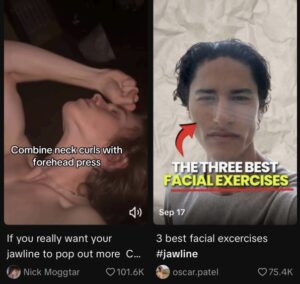
What surprises me the most is how easily I unintentionally fell into the same pattern, and that’s how I mainly found out about this community. On TikTok, I only ever watched basic fitness videos, such as workout clips or gym advice; I never looked for Looksmaxing content. However, at some point, my feed began to change gradually. It was a “glow-up” transformation one day, followed by a video on jawline exercises, and then all of a sudden, I was seeing posts evaluating other men’s faces or outlining which features are considered “low value” or attractive. I didn’t give it much thought at first. But eventually, I noticed that my feed was heavier, more critical, and more focused on flaws that I had never even considered before. It was strange for me to see how the algorithm quietly pushed me toward this type of content, almost like it assumed I was insecure just because I was into the fitness culture.
The fact that these trends have such traction was particularly terrifying to me because they normalize the community’s most harmful and radical beliefs. The more these posts circulate, the more young men internalize the idea that appearance determines value and that self-criticism is not only normal but necessary. A clear example of how these harmful beliefs become normalized can be seen in a Reddit post on r/AsianMasculinity: “Ngl I have been struggling recently with women, and idk if it has anything to do with the way I look. I know I’m not that ugly, but maybe the way I look just isn’t appealing?”(22M Looksmaxxing Advice?). In this post, the guy was asking for advice, and instead of addressing confidence or social skills, almost all of the responses reframe his issue as a technical flaw in his appearance, offering extremely detailed criticisms of his facial structure, jawline definition, eyebrow shape, hairline, and even facial fat. He “lacks forward growth,” according to one commenter, and should start “mewing ASAP.” While others present an almost clinical list of aesthetic corrections, treating his face like a task to fix, as opposed to a person to understand. This feedback situates his insecurities as a problem to be solved, reaffirming the community’s fixation that their attractiveness can be engineered through daily engagement and improvement.
What I consider most troubling about the Looksmaxing community is how the commenters normalize and justify aesthetic surveillance; it suggests the requirement for even a man who considers himself “not ugly” to still identify and resolve flaws in perceived beauty. In this ecosystem, insecurity becomes entertainment, harsh judgments are framed as “advice,” and the pressure to fix one’s appearance is rewarded with likes. As a result, the rise in popularity of Looksmaxing does more than just disseminate a set of beliefs; it also supports a larger digital culture that views comparison, self-monitoring, and discontent as normal aspects of growing up online.
While doing my research, I noticed how standards of beauty in the Looksmaxing community were very strict, and often unrealistic, focusing on features that are believed to be universally “perfect” for men. Participants place a significant importance on general body composition, such as good posture and a degree of muscularity, as well as facial features that anybody would consider “better,” such as jawlines, height, cheekbone prominence, body fat, nose shapes, and eyebrow shape.
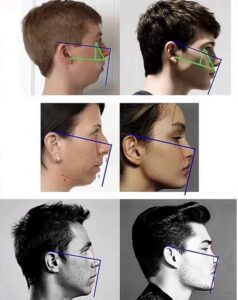
The rigidity of those extreme beauty standards generates a culture of perfection, where even a slight perceived “flaw” is exaggerated. As young men focus on these predetermined ideals, they can begin to engage in a cycle of constantly monitoring themselves.
This fixation can develop into body dysmorphic disorder, a psychological condition characterized by obsessive thoughts about perceived defects, distress about, or embarrassment about defects that others would deem hardly noticeable. According to an article “Those who struggle with body dysmorphia aren’t just annoyed or upset about a perceived defect in their appearance: they can’t stop thinking about physical characteristics they deem to be imperfect, and may experience intense distress, anxiety, or shame about things that appear minor or nonexistent to” (Equip), this evidence shows how the rigid beauty standards in the Looksmaxing community can create an obsessive self-hatred and even lead to mental distress. By taking measurements of themselves that fit specific criteria for facial structure, body composition, and grooming, members may come to experience flaws that do not even exist. The looksmaxing culture normalizes dissatisfaction and produces ideas that every participant should check every single detail of their appearance, which can turn a casual form of insecurity and seek validation into a permanent form of psychological harm.
As I continued to explore the Looksmaxing community, I began to understand how masculinity in these spaces is shaped by beauty standards, along with the larger psychological need for belonging. According to an article, “Social identity theory suggests that individuals derive aspects of their self-identity from the groups in which they are members, with social identity referring to that feeling of alignment, affinity, or identification with those communities”(Online Conversations Between “Real Men”). When I apply this idea to Looksmaxing, it makes perfect sense why so many young men adopt the extreme views of the community when it comes to appearance. Being affiliated gives them belonging and an identity that may not be present in their everyday life. Many of the men I viewed on Reddit forums seemed to be seeking validation and a sense of purpose. The internal language that exists in the Looksmaxing community also helps to create a sense of belonging for its members because it constructs a shared vocabulary that outsiders often don’t understand. Phrases such as “mewing,” “hardmaxxing,” “Chad,” “sub,” and “forward growth” demonstrate a member’s familiarity with the rules and hierarchies of the community. The use of that specific language demonstrates that a member is aligned with the group, which will facilitate their involvement in conversations, contributing advice or responses, and earning social capital within the group.
One of the clearest ways I noticed how Looksmaxing shapes masculine identity is the way in which men recount how they have changed and, afterward, gained social validation. Many young men sincerely believe that if they alter their appearance, they will finally be accepted and respected in their everyday lives, which they have not been able to obtain. When looking at the post titled “Looksmaxxing worked” on Reddit, the user writes: “After years of being made fun of and having no one want to be my friend, looksmaxxing has finally worked for me. It took surgery, skincare, exercise, etc. I still have two more major things to do, but I’m considered handsome by almost everyone (still some people who don’t like the way I look). People are so much nicer to me. Helpful in so many ways. Men and women. Life is such a new experience.” (u/noid79). This post shows how the Looksmaxing community not only provides a list of beauty standards but also a sense of belonging. The user explains years of social rejection, then presents their looksmaxing journey as a transformation into someone who is now “good looking” and treated differently by others. By doing so, they are adopting an assumption from the community that physical attractiveness is the gateway to social acceptance for men and their value as men as well. This is revealing of how masculinity in this context is tied to looks: not just being a “man,” but being the right kind of man who meets the aesthetic standard and is recognized for it.
In conclusion, my immersion in the Looksmaxing community gave me a complicated view of a digital ecosystem that can be understood as both a support community and a source of psychological harm. It is a place where young men, driven by a desire for validation and belonging, are taken advantage of by a series of algorithmic mechanisms that grant value to their most vulnerable insecurities. And that’s my main concern; rather than representing the experience as a healthy sense of self, men in this community are taught to internalize the oppressive standards of this community. I became uncomfortable and even sad to observe such interactions; it was difficult to watch genuine vulnerability being transformed into a clinical and cold assessment of another human without compassion. Now that I have finished this study, I am left with some questions: What happens psychologically to these men who achieve their maximized identity but remain dissatisfied? And how will these rigid digital standards of beauty evolve as this generation ages?. Ultimately, Looksmaxing is more than just a popular trend; it offers a clear representation of a more general digital culture that has normalized self-hatred to the degree that many young men in this situation are convinced that looking different is a technical problem that has to be solved.
Bibliography
Solea, Anda Iulia, and Lisa Sugiura. “Mainstreaming the Blackpill: Understanding the Incel Community on TikTok.” European Journal on Criminal Policy and Research, vol. 29, no. 3, 2023, pp. 311–36, https://doi.org/10.1007/s10610-023-09559-5.
@lthum7m, “22M Looksmaxxing Advice?” Reddit r/AsianMasculinity, 9 Nov. 2025, https://www.reddit.com/r/AsianMasculinity/comments/1gaog30/22m_looksmaxxing_advi ce/
Equip. “What Is Body Dysmorphia and How Does it Relate to Eating Disorders?” National Alliance for Eating Disorders, 11 July 2024, http://www.allianceforeatingdisorders.com/body-dysmorphia/.
“Online Conversations between ‘Real Men’: A Reflexive Thematic Analysis of Sigma Male Discourse on Twitter.” First Monday, 2025, https://doi.org/10.5210/fm.v30i3.13648.
@u/noid79. “Looksmaxxing worked.” r/ugly, Reddit, 14 Dec. 2023, https://www.reddit.com/r/ugly/comments/18e1x48/looksmaxxing_worked/.

